How to Pass Loksewa Exam: The Complete Guide to Success (2026)

Preparing for the Loksewa Exam is one of the biggest dreams for thousands of students and job seekers in Nepal
Preparing for the Loksewa Exam is one of the biggest dreams for thousands of students and job seekers in Nepal. Every year, thousands of candidates compete for a limited number of government positions, making the competition extremely challenging. However, with the right strategy, consistent preparation, and disciplined study habits, passing the Loksewa exam is absolutely achievable.
In this comprehensive guide, you will learn everything you need to know about how to pass the Loksewa exam, including preparation strategies, study plans, recommended books, common mistakes, and expert tips to maximize your chances of success.
Whether you are preparing for Kharidar, Nayab Subba (NASU), Officer Level, or any other Public Service Commission examination, this guide will help you prepare effectively.
Table of Contents
What is the Loksewa Exam?
Understand the Exam Pattern
Know the Complete Syllabus
Create a Smart Study Plan
Build Strong General Knowledge
Improve Nepali and English Language Skills
Master Aptitude and IQ
Practice Previous Year Questions
Time Management Techniques
Best Books for Loksewa Preparation
Importance of Mock Tests
Daily Routine for Loksewa Aspirants
Common Mistakes to Avoid
Interview Preparation
Tips from Successful Candidates
Frequently Asked Questions
Final Thoughts
What is the Loksewa Exam?
The Loksewa Exam is conducted by the Public Service Commission (PSC) of Nepal to recruit qualified candidates for government jobs. These positions offer excellent job security, attractive benefits, career growth, and social prestige.
Popular Loksewa positions include:
Kharidar
Nayab Subba (NASU)
Section Officer
Officer Level
Technical Services
Health Services
Education Services
Administrative Services
Since government jobs are highly respected in Nepal, the competition is intense. Therefore, systematic preparation is essential.
Understand the Exam Pattern
The first step toward passing the Loksewa exam is understanding the examination format.
Generally, the exam consists of:
Objective Questions (Multiple Choice Questions)
Subjective Written Examination
Practical Test (for some technical posts)
Interview
Each level has a different syllabus and marking scheme.
Before starting your preparation:
Download the official syllabus.
Understand subject weightage.
Check the marking system.
Know the passing criteria.
Many candidates waste months studying irrelevant topics simply because they ignore the syllabus.
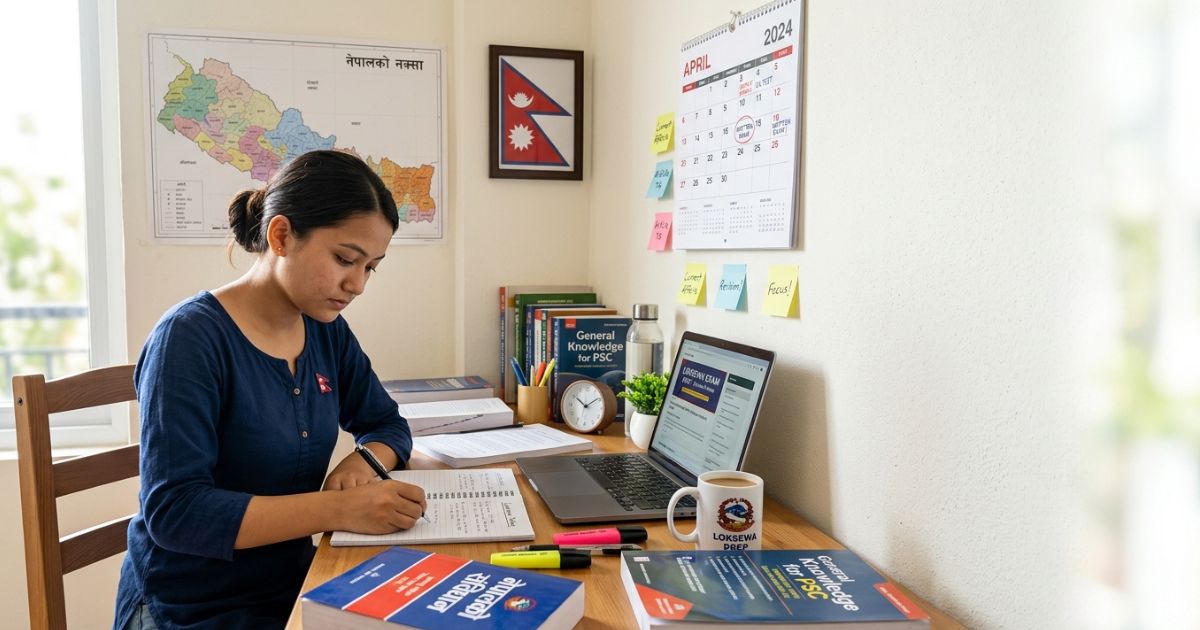
Know the Complete Syllabus
The syllabus is your roadmap.
Every topic mentioned in the syllabus has the potential to appear in the examination.
Study according to the syllabus instead of reading random books.
Break the syllabus into:
General Knowledge
Constitution
Governance
Current Affairs
Mathematics
Logical Reasoning
Nepali Language
English Language
Computer Knowledge
Subject-Specific Topics
Create a checklist and mark every completed topic.
This simple technique keeps your preparation organized.
Create a Smart Study Plan
Without planning, even hardworking students struggle.
A proper study schedule should include:
Morning
Current Affairs
Newspaper Reading
Revision
Afternoon
Main Subject
Theory
Notes
Evening
Practice Questions
Mock Tests
Weak Topics
Night
Quick Revision
Vocabulary
GK Flashcards
Consistency matters more than studying for long hours.
Studying six focused hours daily is often more productive than spending twelve distracted hours with books.
Build Strong General Knowledge
General Knowledge plays a major role in Loksewa examinations.
Focus on:
Nepal
Geography
History
Culture
Constitution
Economy
Politics
Tourism
Provinces
National Parks
International
United Nations
SAARC
ASEAN
World Geography
International Organizations
Global Economy
International Current Affairs
Update yourself daily.
Spend at least 30 minutes reading news every day.
Maintain a notebook for important facts.
Improve Nepali Language Skills
Nepali grammar is one of the scoring sections.
Practice:
Synonyms
Antonyms
Idioms
Sentence Correction
Grammar Rules
Vocabulary
Reading Comprehension
Read Nepali newspapers regularly.
Practice writing short essays.
Writing improves grammar naturally.
Improve English Language Skills
English is another important subject.
Focus on:
Grammar
Vocabulary
Reading Comprehension
Sentence Improvement
Error Detection
Synonyms
Antonyms
Read English newspapers.
Practice one comprehension passage daily.
Learn five new words every day.
Within six months, your vocabulary will improve significantly.
Master Mathematics and Aptitude
Many students fear mathematics.
The truth is:
Loksewa mathematics mainly tests speed and accuracy rather than advanced concepts.
Practice topics like:
Percentage
Ratio
Profit and Loss
Average
Time and Work
Time and Distance
Simple Interest
Compound Interest
Number System
Algebra
Geometry
Data Interpretation
Solve questions using shortcuts.
Time-saving tricks are extremely valuable during the exam.
Practice Logical Reasoning and IQ
Reasoning questions measure analytical ability.
Practice:
Coding-Decoding
Blood Relations
Number Series
Alphabet Series
Seating Arrangement
Direction Sense
Analogy
Classification
Logical Puzzles
Daily practice improves speed dramatically.
Practice Previous Year Questions
This is one of the most effective preparation methods.
Benefits include:
Understanding question patterns
Improving confidence
Identifying weak areas
Learning frequently asked topics
Managing time effectively
Solve at least the last five years of question papers.
Review every mistake carefully.
Make Your Own Notes
Instead of reading bulky books repeatedly, prepare concise notes.
Include:
Important facts
Short definitions
Constitutional articles
Dates
Government schemes
Important personalities
Current Affairs
Use bullet points.
Highlight important keywords.
Revision becomes much easier.
Daily Revision is Essential
Many students focus only on learning new topics.
But revision is equally important.
Follow the 1-7-30 Rule:
Revise after one day.
Revise again after seven days.
Revise again after thirty days.
This method improves long-term memory.
Best Books for Loksewa Preparation
Some commonly recommended study materials include:
General Knowledge
Nepal General Knowledge books
Current Affairs Yearbook
Constitution
Constitution of Nepal
Governance Manuals
Mathematics
Loksewa Mathematics Practice Book
Quantitative Aptitude Guides
English
Objective English
English Grammar Practice
Nepali
Nepali Grammar Books
Loksewa Nepali Guides
Always use the latest editions and align your study materials with the current syllabus.
Importance of Mock Tests
Mock tests simulate the real examination environment.
Benefits include:
Improves confidence
Reduces exam fear
Increases speed
Identifies weak topics
Enhances time management
Take one full mock test every week.
Increase the frequency as the exam approaches.
Learn Time Management
Time management can determine your final score.
During preparation:
Set daily goals.
Track your progress.
Avoid procrastination.
During the exam:
Solve easy questions first.
Skip difficult questions initially.
Return later if time permits.
Keep five to ten minutes for review.
Never spend excessive time on one question.
Stay Updated with Current Affairs
Current affairs are crucial.
Follow:
National News
Government Policies
Budget Announcements
International Events
Sports
Science and Technology
Awards
Important Days
Maintain monthly current affairs notes.
Revise them every weekend.
Develop Writing Skills
For descriptive examinations, writing quality matters.
Practice:
Essay Writing
Letter Writing
Report Writing
Official Correspondence
Government Formats
Write at least one essay every week.
Focus on:
Clear structure
Grammar
Presentation
Logical flow
Maintain Physical and Mental Health
Good health supports effective learning.
Remember to:
Sleep 7–8 hours.
Exercise regularly.
Eat nutritious food.
Stay hydrated.
Take short study breaks.
Limit excessive social media use.
Avoid burnout by balancing study with rest.
Common Mistakes to Avoid
Many candidates fail because of avoidable mistakes.
These include:
Ignoring the syllabus
Studying without a plan
Skipping revision
Not practicing mock tests
Depending only on coaching classes
Ignoring previous question papers
Poor time management
Last-minute cramming
Neglecting current affairs
Giving up after setbacks
Recognizing these pitfalls early can significantly improve your performance.
Interview Preparation
If you pass the written examination, the interview is the final stage.
Prepare by:
Learning about your academic background
Understanding your chosen service sector
Reading current affairs
Practicing communication skills
Improving confidence
Wearing formal attire
Speaking politely and honestly
Interviewers often evaluate confidence, communication, honesty, and decision-making skills in addition to technical knowledge.
Tips from Successful Loksewa Candidates
Many successful candidates follow similar habits.
They:
Study consistently every day.
Focus on the syllabus.
Solve previous papers repeatedly.
Revise regularly.
Read newspapers daily.
Practice mock tests.
Learn from mistakes.
Stay patient and disciplined.
Success usually comes from consistent effort rather than shortcuts.
Sample Daily Study Routine
Here is an example schedule for full-time aspirants:
6:00 AM – 7:00 AM
Current Affairs and newspaper reading
7:00 AM – 9:00 AM
Core subject study
10:00 AM – 12:00 PM
Mathematics and reasoning
1:00 PM – 3:00 PM
General Knowledge and Constitution
4:00 PM – 5:00 PM
Practice questions
6:00 PM – 8:00 PM
Revision and note-making
9:00 PM – 9:30 PM
Vocabulary and quick review
Adjust this routine according to your personal commitments and energy levels.
Frequently Asked Questions (FAQs)
How many hours should I study for the Loksewa exam?
Quality matters more than quantity. Most successful candidates study between 5 and 8 focused hours per day, depending on their schedule.
Is coaching necessary?
No. Coaching can provide structure, but many candidates pass through disciplined self-study using the syllabus, quality books, and regular practice.
How long does it take to prepare?
Preparation time varies by background and the level of the exam. Many candidates prepare seriously for six months to one year.
Are previous year question papers important?
Yes. They help you understand the exam pattern, identify recurring topics, and improve time management.
What is the best way to improve General Knowledge?
Read newspapers daily, follow reliable current affairs sources, revise regularly, and maintain concise notes for quick review.
Final Thoughts
Passing the Loksewa exam is not about luck—it is about planning, consistency, and perseverance. Every successful candidate begins with the same syllabus, but disciplined preparation makes the difference.
Start by understanding the exam pattern, create a realistic study schedule, focus on the official syllabus, practice previous years' questions, take regular mock tests, and revise consistently. Along with academic preparation, maintain your physical and mental well-being so you can stay motivated throughout your journey.
Remember that progress may seem slow at times, but every chapter you complete, every mock test you take, and every revision session brings you one step closer to your goal. Stay committed, learn from your mistakes, and keep improving.
With determination, patience, and the right preparation strategy, you can confidently clear the Loksewa exam and achieve your dream of serving the nation through a respected government career.
Best of luck with your Loksewa preparation!